


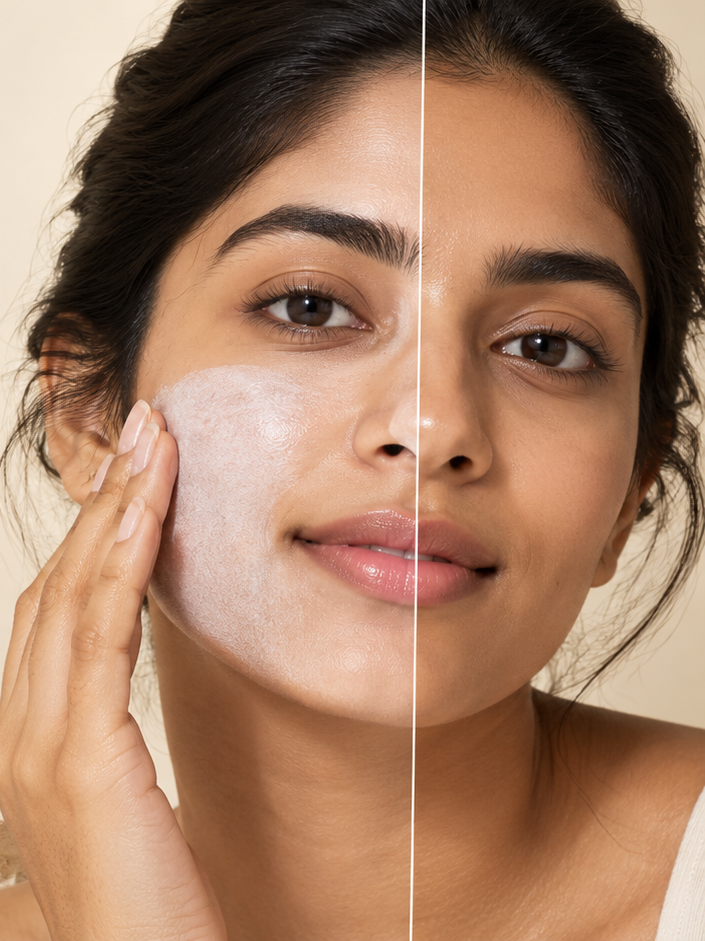
You smooth sunscreen on in the bathroom and the mirror says you’re fine. Then you step into daylight and there it is: a grey film along your jaw, a chalky ring around your nose. By Thursday, the bottle is back in the drawer.
That’s the real cost of picking the wrong sunscreen. A sunscreen with no white cast for Indian skin is one you’ll actually want to wear every day, and consistency matters.
Most Indian skin sits around Fitzpatrick types III to V, and UVA exposure can contribute to pigmentation and dark spots. That makes choosing a sunscreen with strong UVA protection especially important if pigmentation is one of your concerns.
Here’s how to choose a sunscreen that works for your skin, how to check for white cast, and what to look for before you buy.
There are four things worth checking:
1. Filter Type
Untinted mineral sunscreens containing zinc oxide or titanium dioxide can be more likely to leave a visible cast.
Chemical sunscreens generally have a lower risk of visible white cast.
Hybrid sunscreens fall somewhere between the two, depending on the mineral filters and their concentration.
2. SPF and UVA Protection
Look for SPF 50 if you want a higher level of UVB protection and a margin for real-world application.
For UVA protection, look for a high UVA rating such as PA++++.
3. Texture
A lightweight gel, fluid or serum-like sunscreen can feel more comfortable for daily use than a thick cream, particularly if you have oily or combination skin.
4. The Actual Finish
A product claiming “no white cast” isn’t enough by itself.
Apply the sunscreen properly and check how it looks on your own skin in natural daylight.
A formula that disappears on one person’s skin can still look slightly grey or chalky on another skin tone.
Why Does Sunscreen Leave a White Cast on Indian Skin?
Mineral UV filters such as zinc oxide and titanium dioxide sit on the surface of the skin and scatter light.
Depending on the formulation, particle size and concentration, this can create a visible white or grey appearance.
The effect can be more noticeable on medium to deep skin tones.
Chemical UV filters work differently. They absorb UV radiation rather than relying on the same light-scattering effect, which is why chemical sunscreens generally have a lower risk of visible white cast.
Two terms you may see on sunscreen labels are:
Micronized: refers to smaller particles that can reduce visible scattering.
Non-nano: this describes particle size and should not automatically be treated as a quality rating.
Mineral, Chemical, Hybrid or Tinted: What Suits Indian Skin?
| Formula type | White cast risk | Good fit | Watch out for |
| Untinted mineral | Higher | People who prefer or need mineral filters | Can look chalky on medium to deep skin |
| Tinted mineral | Lower to none when well matched | Pigmentation concerns and people who prefer mineral formulas | Shade needs to match |
| Chemical | Generally low | Everyday sunscreen use | Can irritate some people |
| Hybrid | Low to moderate | People looking for a middle ground | Depends on the mineral filter content |
There is no single sunscreen type that is perfect for everyone.
Your skin type, sensitivity, pigmentation concerns, climate and personal preference all matter.
The Case for Tinted Sunscreen
White cast isn’t the only consideration for deeper skin tones.
Visible light can contribute to pigmentation, particularly in people prone to melasma and other pigmentation concerns.
Tinted sunscreens containing iron oxides can provide additional protection against visible light compared with an untinted sunscreen.
However, shade matters.
One universal tint will not necessarily match every Indian skin tone. If you are buying a tinted sunscreen, match the shade to your face or neck rather than your wrist.
If pigmentation or melasma is your main concern, speak with a dermatologist about the most appropriate sunscreen for your skin.
Match the Texture to Your Skin Type
Oily Skin
Look for a lightweight, gel or matte-finish sunscreen that doesn’t feel excessively greasy.
Dry Skin
A more hydrating sunscreen with a comfortable finish may work better.
Combination Skin
A lightweight sunscreen that doesn’t feel heavy around the nose and chin can be a good option.
Sensitive Skin
If your skin reacts easily, consider formulas designed for sensitive skin and patch test before using a new sunscreen regularly.
If you spend a lot of time outdoors or sweat heavily, also consider whether the sunscreen offers appropriate water or sweat resistance.
Where DAARC Zero Trace Sunscreen Fits
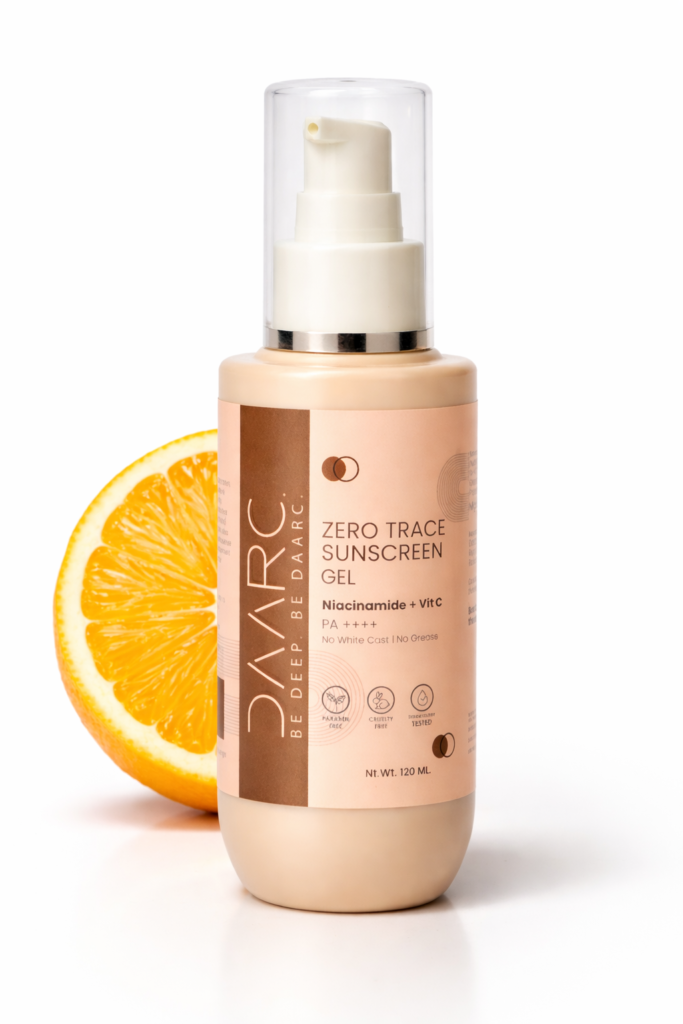
When choosing a daily sunscreen, protection is only part of the equation. The sunscreen also needs to feel comfortable enough to use consistently and look good on your skin.
DAARC Zero Trace Sunscreen is designed as a lightweight sunscreen with a non-greasy finish and zero-white-cast positioning.
DAARC Zero Trace Sunscreen
- Size: 120 ml
- SPF: 50 PA++++
- Key ingredients: Niacinamide, Rice Water, Vitamin C, Aloe Vera and Orange Peel Oil
- Texture: Lightweight
- Finish: Non-greasy
- White cast: Zero white cast
- Dermatologist tested
- Cruelty-free
- GMP certified
Why Choose DAARC Zero Trace Sunscreen?
A sunscreen becomes much easier to use consistently when it feels comfortable on the skin.
DAARC Zero Trace Sunscreen is formulated with a lightweight, non-greasy finish and is designed to provide a zero-white-cast appearance.
The formula also contains skincare-focused ingredients including Niacinamide, Rice Water, Vitamin C and Aloe Vera.
The goal isn’t simply to find the highest SPF number on a bottle. You want protection that fits naturally into your everyday skincare routine.
DAARC Zero Trace Sunscreen and White Cast
One of the biggest concerns with sunscreen among medium and deeper Indian skin tones is a visible white or grey cast.
DAARC Zero Trace Sunscreen is positioned around a zero-white-cast finish, making it an option for people who want daily sunscreen without an obvious chalky appearance.
However, sunscreen appearance can vary depending on skin tone, application amount, lighting and how the formula settles.
The best way to judge the finish is to apply the recommended amount and check your skin in natural daylight.
If you have actual testing data across different skin tones, you can strengthen this section by adding it here.
Key Ingredients in DAARC Zero Trace Sunscreen
Niacinamide
Niacinamide is a widely used skincare ingredient that supports the skin barrier and is commonly included in formulas designed to improve the appearance of uneven skin tone.
Rice Water
Rice water is included as part of the formula and is commonly used in skincare focused on hydration and skin conditioning.
Vitamin C
Vitamin C is a popular antioxidant ingredient used in skincare routines focused on brightening and protecting the skin from environmental stressors.
Aloe Vera
Aloe vera is commonly used in skincare formulations for its soothing and hydrating properties.
Orange Peel Oil
Orange peel oil is included as part of the formula’s ingredient blend.
Is DAARC Zero Trace Sunscreen Suitable for Indian Skin?
Indian skin tones range from very light to deep, so no sunscreen should be judged only by how it looks on one person.
A sunscreen with a lightweight texture and no obvious white cast can be particularly useful for people who find traditional sunscreens visibly chalky on their skin.
DAARC Zero Trace Sunscreen is designed with a zero-white-cast finish and a lightweight, non-greasy feel.
As with any skincare product, individual experiences can vary. The best way to assess the finish is to apply the sunscreen to your own skin and check it in natural daylight.
Frequently Asked Questions
Does SPF 50 PA++++ mean no white cast?
No.
SPF and PA describe the level of UV protection. They do not determine whether a sunscreen will leave a visible white cast.
White cast depends on factors including the UV filters, formulation, particle size, texture and skin tone.
Which leaves less cast, mineral or chemical sunscreen?
Chemical sunscreens generally have a lower risk of visible white cast.
Hybrid sunscreens can also have a relatively low risk depending on their mineral filter content.
Tinted mineral sunscreens can reduce the visible appearance of a white cast when the shade matches the skin.
Does DAARC Zero Trace Sunscreen leave a white cast?
DAARC Zero Trace Sunscreen is designed with a zero-white-cast finish.
For the best assessment, apply the recommended amount and check the finish in natural daylight.
Is DAARC Zero Trace Sunscreen suitable for Indian skin?
DAARC Zero Trace Sunscreen is designed with a lightweight, non-greasy and zero-white-cast finish, making it an option for people looking for comfortable daily sunscreen.
As skin tones and individual preferences vary, checking the finish on your own skin is recommended.
What are the key ingredients in DAARC Zero Trace Sunscreen?
The formula includes Niacinamide, Rice Water, Vitamin C, Aloe Vera and Orange Peel Oil.
Is DAARC Zero Trace Sunscreen SPF 50?
Yes, provided SPF 50 is confirmed on your current product packaging and supporting documentation.
Do I need sunscreen every day?
Daily sunscreen is an important part of protecting your skin from UV exposure.
Consistent use can be particularly important if you are concerned about pigmentation and sun-induced skin changes.
Does sunscreen whiten dark skin?
No.
Sunscreen does not permanently whiten your natural skin colour.
Some sunscreens can temporarily make skin appear lighter because of a visible white cast, but this is a cosmetic effect.
Do darker skin tones need sunscreen?
Yes.
Darker skin still experiences UV exposure and can develop pigmentation and other forms of sun-related skin damage.
Can I wear makeup over sunscreen?
Yes.
Allow the sunscreen to settle before applying makeup.
Final Takeaway
The best sunscreen isn’t simply the one with the biggest SPF number on the bottle.
It is a sunscreen that provides appropriate UV protection, feels comfortable enough to use consistently and works well with your skin tone and routine.
For Indian skin, particularly medium to deeper skin tones, avoiding an obvious white cast can make daily sunscreen much easier to stick with.
Look for the right combination of UV protection, texture, finish and formulation, and always assess the sunscreen on your own skin in natural daylight.
If you’re looking for a lightweight sunscreen with a non-greasy, zero-white-cast finish, DAARC Zero Trace Sunscreen is one option to consider.